Dhaka
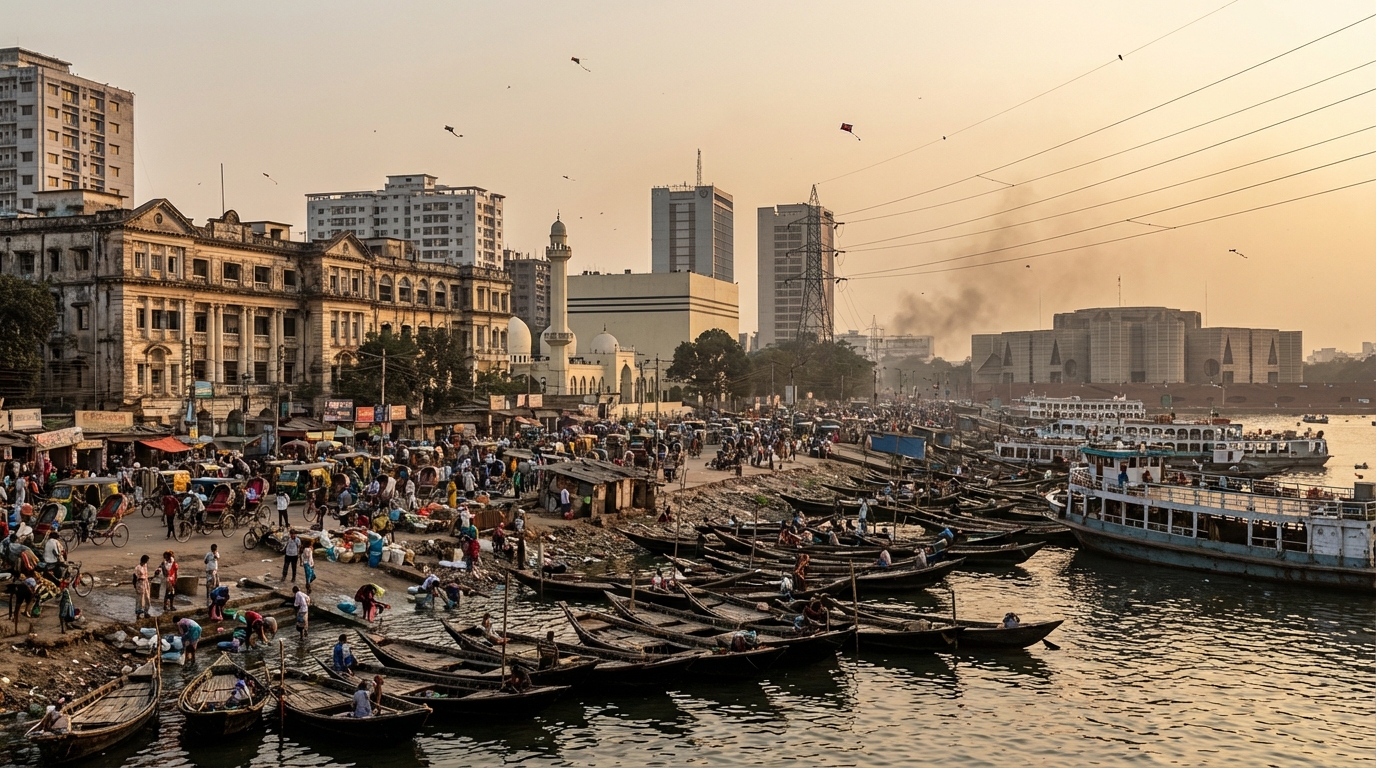
Dhaka is a region of Bangladesh. Dhaka serves as the central pulse of Bangladesh, anchored by the Buriganga River. It is a dense urban landscape where thousands of cycle rickshaws navigate a humid, alluvial terrain.
Geography
Standing on the red lateritic soil of the Madhupur Tract, Dhaka is slightly elevated above the surrounding floodplains. With temperatures hitting 40°C in April, the city experiences 2,000mm of annual rainfall, creating a humid atmosphere that smells of rain-soaked earth and exhaust.
History
In 1610, Subahdar Islam Khan I designated Dhaka the Mughal capital. He established its borders by having a drum beaten, declaring that the city would extend as far as the sound reached, marking its transition into a global hub for fine muslin.
Landmarks
- Lalbagh Fort: Construction halted in 1684; the tomb of Pari Bibi features rare white marble and black basalt transported from Rajmahal by elephants.
- Ahsan Manzil: This pink palace contains 23 galleries where 19th-century Dutch floor tiles reflect the light of the nearby Buriganga River.
- National Parliament House: Completed in 1982 by Louis Kahn, the concrete structure uses geometric voids to circulate air without modern cooling systems.
- Hatirjheel: A 2013 urban renewal project, this 300-acre site acts as a storm-water reservoir with bridges that glow under LED lights.
- Purbachal 300 Feet Road: A newly developed 8-lane corridor where locals gather at night to eat clay-pot duck curry amidst the expanding city limits.
Cuisine
The local kitchen relies on mustard oil and a five-spice blend called panch phoron. Preparation often involves slow-cooking in heavy aluminum dekchis to ensure meats remain tender despite the high humidity.
- Kacchi Biryani: Raw mutton is layered with aromatic Kalijira rice and potatoes, then sealed with flour dough to steam in its own juices.
- Bakarkhani: A dry, biscuit-like flatbread from the Mughal era, traditionally prepared in clay ovens and eaten with spicy meat or sweetened milk.
- Bhuna Khichuri: A dense mixture of roasted moong dal and rice, typically served with fried eggplant during the heavy monsoon rains.
- Borhani: A savory yogurt drink blended with mint, black salt, and green chili, traditionally served at weddings to aid digestion.
- Seven-Layer Tea: A glass showing seven distinct bands of varying tea strengths and spices, creating a sweet and salty sensory experience.
Culture
Life revolves around the Bengali calendar and the cycle of the seasons. Residents transition between traditional cotton attire and modern styles while celebrating events that honor the Bengali language and history.
- Pohela Boishakh: Celebrated on April 14th, the day begins with the Mongol Shobhajatra parade featuring massive paper-mâché folk masks and traditional music.
- Shakrain: On January 14th, rooftops in Old Dhaka become stages for kite fighting, fire-breathing performances, and synchronized firework displays.
- Ekushey February: Every February 21st, thousands walk barefoot to the Shaheed Minar to lay flowers, honoring the 1952 movement for the Bengali language.
- Jamdani Saree: Hand-woven on pit looms with 100-count cotton, these sarees feature geometric patterns that signify high social status and craftsmanship.
- Panjabi: A knee-length cotton tunic with embroidery around the neck, worn by men for religious services and formal gatherings in humid weather.
- Lungi: A seamless cotton tube wrapped around the waist, offering essential ventilation for men working or relaxing in the city's heat.
- Salwar Kameez: A three-piece outfit comprising trousers and a long tunic, preferred by women for daily commutes due to its comfort and modesty.
- Topi: An intricately crocheted prayer cap worn by men, representing religious devotion and a common sight in the city's historic neighborhoods.