Fujian
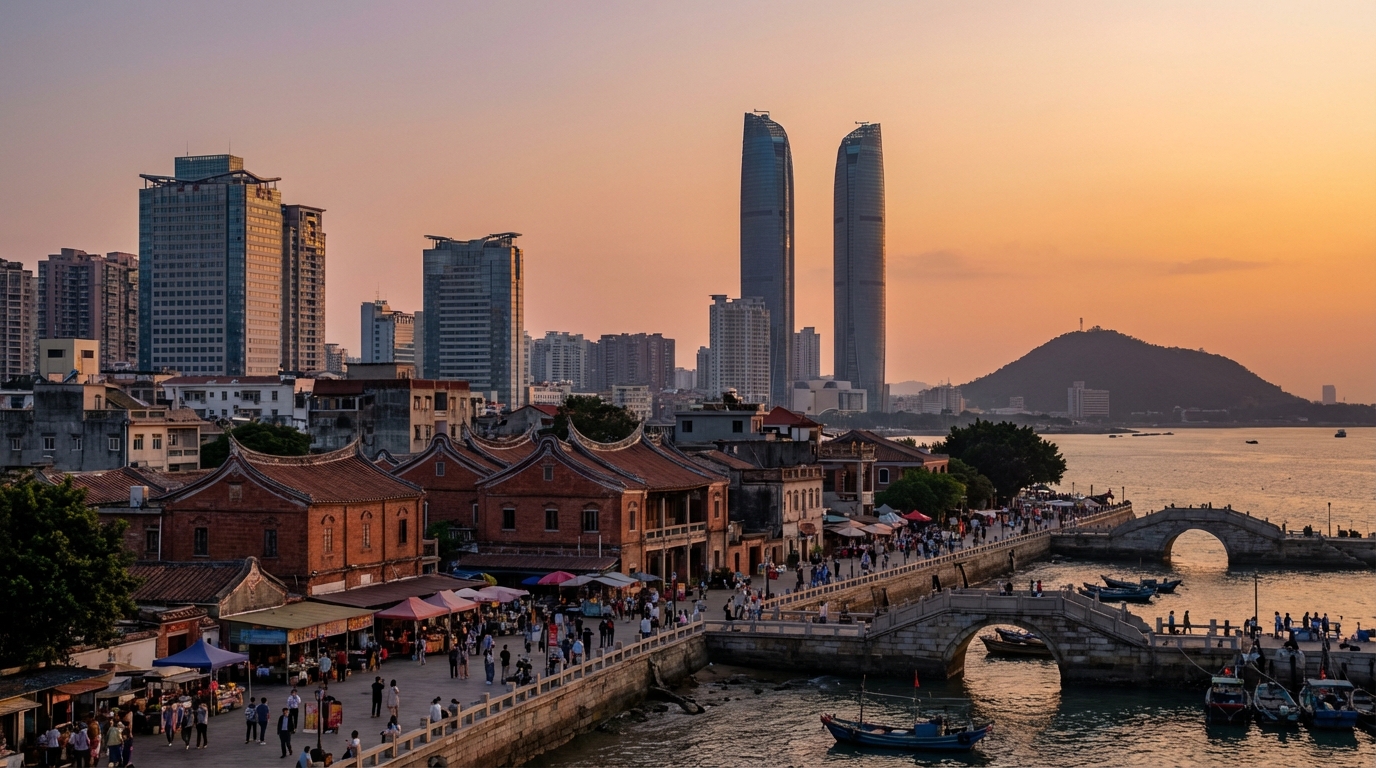
Fujian is a region of China. Fujian sits on China's southeast coast, defined by a jagged 3,752-kilometer shoreline and a landscape that is 90% mountainous. It serves as the ancestral home of a vast global diaspora and the historical starting point of the maritime silk road.
Geography
The province is dominated by the Wuyi Mountains, where 1,000-meter peaks trap coastal moisture to create constant mist. To the east, the Taiwan Strait provides a deep-water coastline with over 1,500 islands, resulting in a humid subtropical climate where rainfall averages 1,400mm annually.
History
In 1405, Admiral Zheng He gathered a fleet of 250 ships in the Min River estuary near Changle. This departure transformed Fujian into a global maritime hub, establishing trade routes that connected Quanzhou to 90 different ports across the Indian Ocean and Africa.
Landmarks
- Chengqilou: A circular earthen fortress built in 1708 with 400 rooms, featuring four concentric rings that house 800 residents in a single structure.
- Twin Pagodas of Kaiyuan Temple: Constructed in 1237, these 48-meter granite towers survived a magnitude 8.0 earthquake in 1604 without losing a single structural stone.
- Wuyishan Tea Plantations: Tea plants grow in sandstone crevices across 36 peaks, where hand-picked leaves are charcoal-roasted for 10 hours to create mineral flavors.
- Gulangyu Piano Museum: This facility houses 100 historical pianos, including an 1824 Clementi, on an island with the world's highest piano-per-capita ratio.
- Fuzhou Strait Culture and Art Centre: A 2018 complex shaped like jasmine flowers, built with 150,000 pieces of white ceramic that mimic the texture of fine porcelain.
Cuisine
Min cuisine relies on 'Shuangtang' techniques and red yeast rice fermentation. Chefs utilize over 20 types of soup bases, emphasizing umami from dried scallops and razor clams rather than heavy oils. Precision in knife work is paramount, with ingredients often sliced as thin as hair to absorb flavors rapidly during a quick braise.
- Buddha Jumps Over the Wall: Simmers 30 ingredients, including abalone and sea cucumber, in a clay jar sealed with lotus leaves for 10 hours.
- Yanpi: Pork leg meat is pounded 10,000 times with wooden mallets until it becomes a paper-thin, translucent sheet used for dumpling wrappers.
- Oyster Omelet: Uses small 'pearl oysters' from the Min River estuary, bound with sweet potato starch to create a distinctively chewy, gelatinous texture.
- Da Hong Pao: Charcoal-roasted Oolong tea from 300-year-old bushes grown in volcanic rock soil, known for its heavy minerals and smoky, floral aroma.
- Tieguanyin: An 18th-century Oolong variety from Anxi, hand-rolled into tight green pearls that unfurl only when steeped in 95-degree Celsius water.
Culture
Fujian culture is a mosaic of Minnan, Hakka, and Fuzhou traditions, characterized by the worship of the sea goddess Mazu. The region is linguistically diverse, preserving eight-tone dialects that predate modern Mandarin. Festivals often involve intricate puppetry and tea ceremonies that serve as the primary social fabric for village communities.
- Mazu's Birthday: On the 23rd day of the 3rd lunar month, thousands carry wooden goddess statues to Meizhou Island to burn sandalwood incense.
- Mid-Autumn Mooncake Gambling: A 300-year-old tradition where players roll six dice into ceramic bowls, winning prizes based on combinations like 'Four Red Fours'.
- Putian Lantern Festival: Celebrated on the 15th day of the 1st lunar month, featuring 50,000 lanterns and ritual barefoot climbs up blade-covered ladders.
- Hui'an Yellow Jacket: A short yellow top exposing the navel, paired with wide black trousers, allowing coastal women to work in humid sand.
- Xunpu Floral Headband: Elderly women wrap fresh jasmine and carnations in concentric circles around a silver hair pin, a tradition spanning 800 years.
- Hakka Blue Shirt: An indigo-dyed cotton tunic with a side-fastening overlap, designed in 1850 for durability while farming steep mountain terraces.
- Fuzhou Silk Jacket: High-collared wedding attire made of 'tushigao' silk, featuring gold-thread embroidery of peonies to symbolize prosperity and family longevity.
- Embroidered Velvet Shoes: Traditional cloth shoes with 5-centimeter thick cotton soles, hand-stitched with silk floral motifs to absorb moisture in the coastal humidity.