Guangdong
Guangdong is a region of China. Guangdong anchors the Pearl River Delta in South China, serving as a humid gateway where the Nanling Mountains meet the South China Sea. It is the nation's industrial engine, defined by the rapid transformation of fishing villages into megalopolises like Shenzhen and Guangzhou.
Geography
Spanning 179,800 square kilometers, Guangdong's 4,114-kilometer coastline meets the South China Sea. The Nanling Mountains shield the delta from northern frosts, maintaining a 22-degree Celsius average. The Pearl River basin delivers 300 billion cubic meters of water annually, creating a humid, amphibious landscape where freshwater and saltwater ecosystems collide in the dense mangrove forests of the Zhujiang estuary.
History
In 1978, Deng Xiaoping designated Shenzhen as a Special Economic Zone, shifting the region's trajectory. This pivotal decision invited foreign capital, transforming a rural county of 30,000 people into a technology hub of 17 million within four decades. This opening policy catalyzed the province's transition from an agricultural backwater to the world's workshop, anchoring the global supply chain.
Landmarks
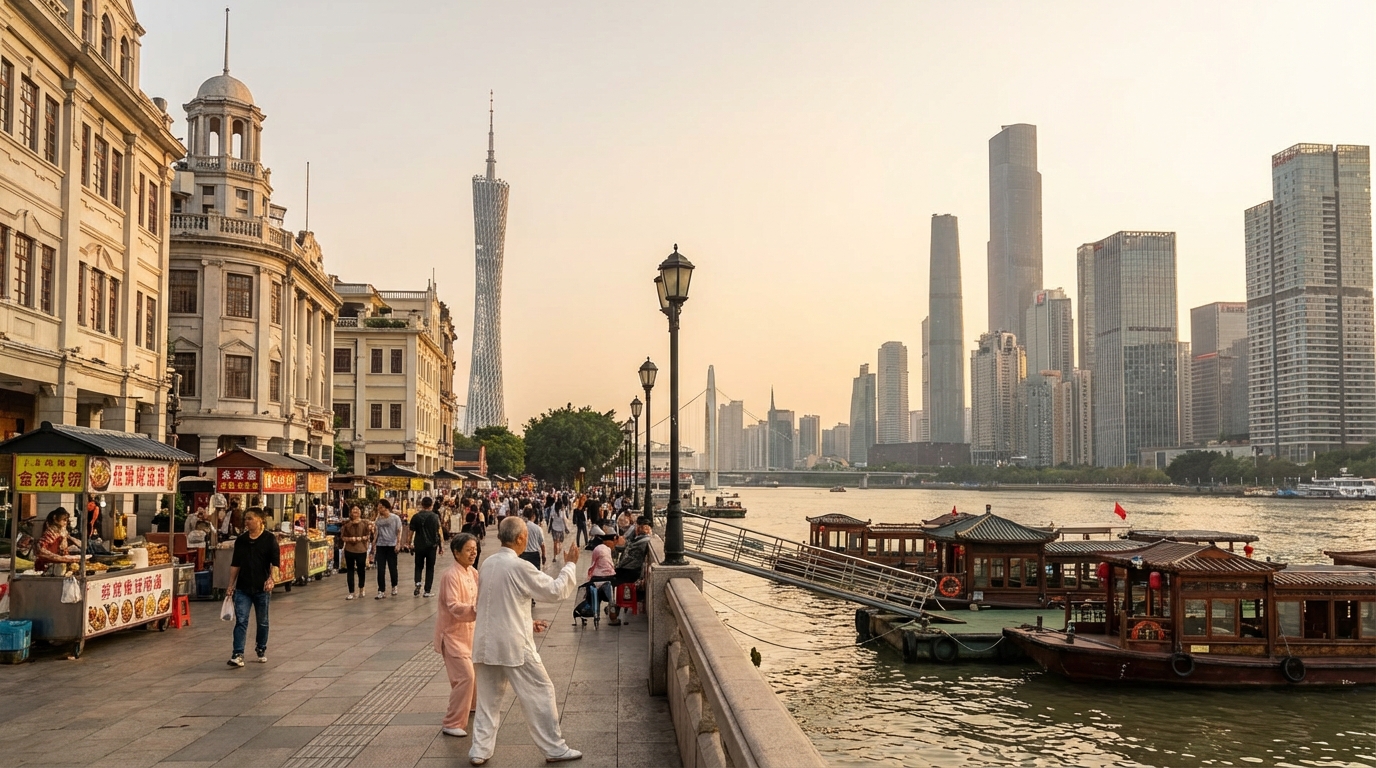
- Canton Tower: Rising 600 meters, its 'waist' measures only 30 meters wide, making it one of the world's thinnest high-rise silhouettes.
- Chen Clan Ancestral Hall: Built in 1894, it features 11 ridges of pottery sculptures depicting Cantonese opera scenes in precise, multicolored ceramic detail.
- Kaiping Diaolou: These 1,833 fortified towers blend Romanesque arches with Chinese roofs, built by returning emigrants to repel 1920s bandits.
- DJI Sky City: Completed in 2022, two 200-meter towers are connected by a 90-meter suspension bridge where engineers test heavy-lift delivery drones.
- MOCAUP Cloud: A 25-meter-high mirror-polished stainless steel structure in Shenzhen that reflects the sky, symbolizing the city's fluid, rapid evolution.
Cuisine
Cantonese cooking prioritizes freshness, utilizing 200-degree 'Wok Hei' to sear ingredients instantly. Chefs often source seafood minutes before preparation, emphasizing natural sweetness over heavy spices. This 2,000-year-old culinary tradition focuses on the harmony of textures, from the crunch of jellyfish to the silkiness of steamed egg, reflecting the region's abundance of river and sea resources.
- Har Gow: These translucent shrimp dumplings must have at least ten pleats, a technique perfected in 1920s Guangzhou teahouses.
- White Cut Chicken: Poached in sub-boiling water with ginger, the skin remains snappy, served cold to highlight the natural poultry flavor.
- Claypot Rice: Cooked over charcoal in 400-degree ceramic pots, this dish is prized for the 'guoba'—the crunchy, toasted rice layer at the bottom.
- Liangcha: Brewed from 24 bitter herbs, locals drink this black liquid daily to balance internal 'heat' in the humid climate.
- Phoenix Dancong: Harvested from 600-year-old trees, this tea naturally mimics the scent of honey or orchids without any added flavorings.
Culture
Lingnan culture is defined by nine-toned Cantonese and a pragmatic merchant spirit. Traditional life revolves around 'Yum Cha' rituals and intricate woodcarvings found in clan halls. The culture blends maritime openness with ancient traditions, visible in the elaborate Lion Dances that use 5-kilogram hand-painted heads to perform acrobatic feats during temple fairs.
- Dragon Boat Festival: On the fifth lunar month, villages compete in 30-meter teak boats, splashing water to ensure health and ward off spirits.
- Canton Fair: Established in 1957, this biannual event draws 200,000 global buyers to Guangzhou, generating billions in manufacturing contracts.
- Lunar New Year Flower Fair: During the spring transition, locals walk through nighttime markets to buy kumquat trees, symbolizing luck for the coming year.
- Xiangyunsha: This 'mud silk' is dyed with yam juice and buried in river mud, creating a breathable, metallic-black finish.
- Cantonese Qipao: These involve shorter hemlines and lighter silks suited for the 90% humidity found in southern Chinese summers.
- Hakka Bamboo Hat: Worn by field workers, these flat woven circles feature a distinctive black fringe veil to deter insects.
- Tangzhuang: A formal jacket with frog buttons, often made of silk brocade for elders during traditional 60th birthday banquets.
- Nanyue Sandal: Simple grass or leather footwear designed for the rainy season, allowing water to drain instantly during monsoons.