Czechia
Czechia is a country. Landlocked in the geographical center of Europe, the Czech Republic is a mountain-rimmed basin defined by the Bohemian Massif. It is most striking for its density of over 2,000 castles and a society that balances industrial precision with a dry, satirical humor.
Geography
The 78,866 square kilometers are defined by natural mountain borders. In the north, the Labe river carves a sandstone canyon at Hřensko, the country's lowest point at 115 meters, where the air is noticeably damp and 5 degrees cooler than the surrounding plains. The terrain is a mix of rolling hills and the high Sudetes range, where the Sněžka peak reaches 1,603 meters.
History
On November 17, 1989, the Velvet Revolution began when 500,000 citizens gathered in Letná Park. Václav Havel led the crowd as they jingled metal keys in the air, a sound symbolizing the unlocking of doors to democracy. This peaceful transition ended four decades of communist rule without a single shot fired, leading to the creation of the modern state on January 1, 1993.
Landmarks
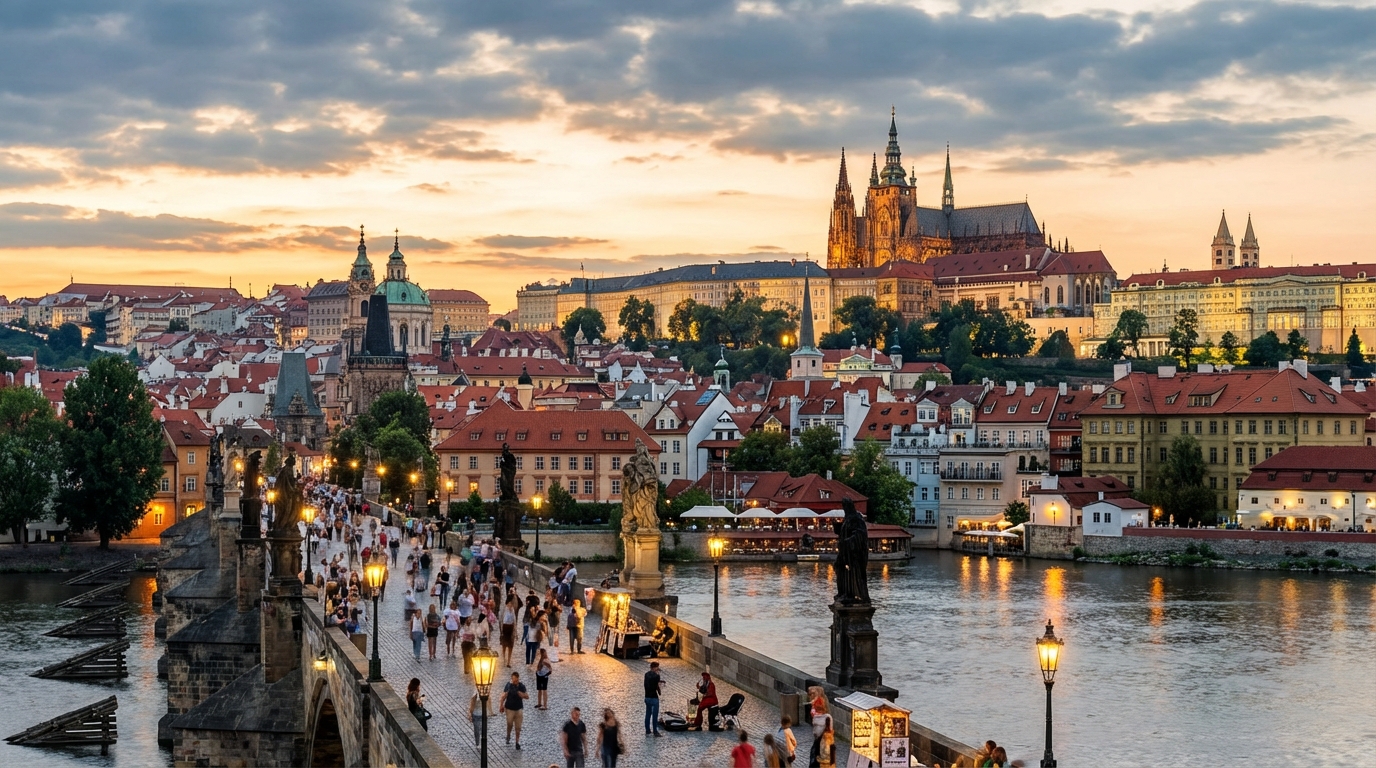
- Charles Bridge: Completed in 1402, the bridge is reinforced with 16 arches; legend says workers mixed raw egg yolks into the mortar to strengthen the stone.
- Prague Castle: Spanning 70,000 square meters, this complex includes the Vitus Cathedral, which contains a 2.5-ton solid silver tomb for Saint John of Nepomuk.
- Sedlec Ossuary: This 14th-century chapel features a massive chandelier containing at least one of every bone in the human body, sourced from 40,000 skeletons.
- Sky Bridge 721: Opened in 2022, this 1.2-meter wide suspension walkway stretches 721 meters across the Mlýnský Stream valley, hanging 95 meters above the forest floor.
- Dolní Vítkovice: A former 19th-century ironworks in Ostrava where visitors climb a rusted 80-meter tall blast furnace that has been converted into a glass-walled lookout.
Cuisine
Czech cuisine focuses on heat-retention for cold winters, utilizing heavy gravies and fermented sides. Preparation relies on 'jížka' (roux) and slow-braising. Textures are often contrasting, pairing the porous, soft 'knedlíky' (dumplings) with the crisp skin of roasted duck or the sharp acidity of sauerkraut.
- Svíčková na smetaně: Beef sirloin braised in root vegetables and cream, served with a single dollop of cranberry jam and a slice of lemon for acidity.
- Kulajda: A creamy South Bohemian soup made with forest mushrooms, potatoes, and dill, featuring a poached egg that releases yolk into the vinegar-spiked broth.
- Ovocné knedlíky: Sourdough dumplings filled with whole plums, then buried under a layer of grated 'tvaroh' cheese, powdered sugar, and 50 grams of melted butter.
- Pilsner Urquell: First brewed in 1842 using Saaz hops; it must be served with a 35-millimeter thick head of wet foam to preserve the carbonation.
- Becherovka: A bitters produced in Karlovy Vary since 1807; it contains 20 secret herbs and must be chilled to minus 5 degrees Celsius before serving.
Culture
Culture is deeply tied to the 'chata' (weekend cabin) lifestyle and Moravian folklore. Traditional life revolves around the agricultural calendar, with a high value placed on 'pohoda'—a state of relaxed contentment. Craftsmanship is visible in glassblowing and the intricate, labor-intensive starching of folk costumes used in village ceremonies.
- Ride of the Kings: A UNESCO-listed Moravian festival where a boy in female dress rides a white horse with a paper rose held firmly in his teeth.
- Burning of the Witches: Celebrated every April 30, locals build 5-meter tall bonfires to burn straw effigies, symbolizing the end of winter and the banishing of evil.
- St. Nicholas Eve: On December 5, trios dressed as an Angel, Saint, and a rattling, chain-carrying Devil walk the streets to reward or playfully threaten children.
- Kyjov Kroj: A ceremonial dress with sleeves so heavily starched they remain rigid and stand out 20 centimeters from the wearer's shoulders.
- Modrotisk Apron: Indigo-dyed fabric printed using 18th-century wooden blocks; the white patterns are created by a resist-paste made from gum arabic and clay.
- Holínky: Men's high leather boots polished with bone black until they reflect like mirrors, worn during the folk dances of South Moravia.
- Věneček: A floral crown woven from local meadow flowers and silk ribbons, worn by unmarried women to symbolize youth and seasonal fertility.
- Kordula: A stiff, short vest worn by men, decorated with precisely 24 metal buttons and hand-stitched floral embroidery representing the local parish.