Cairo
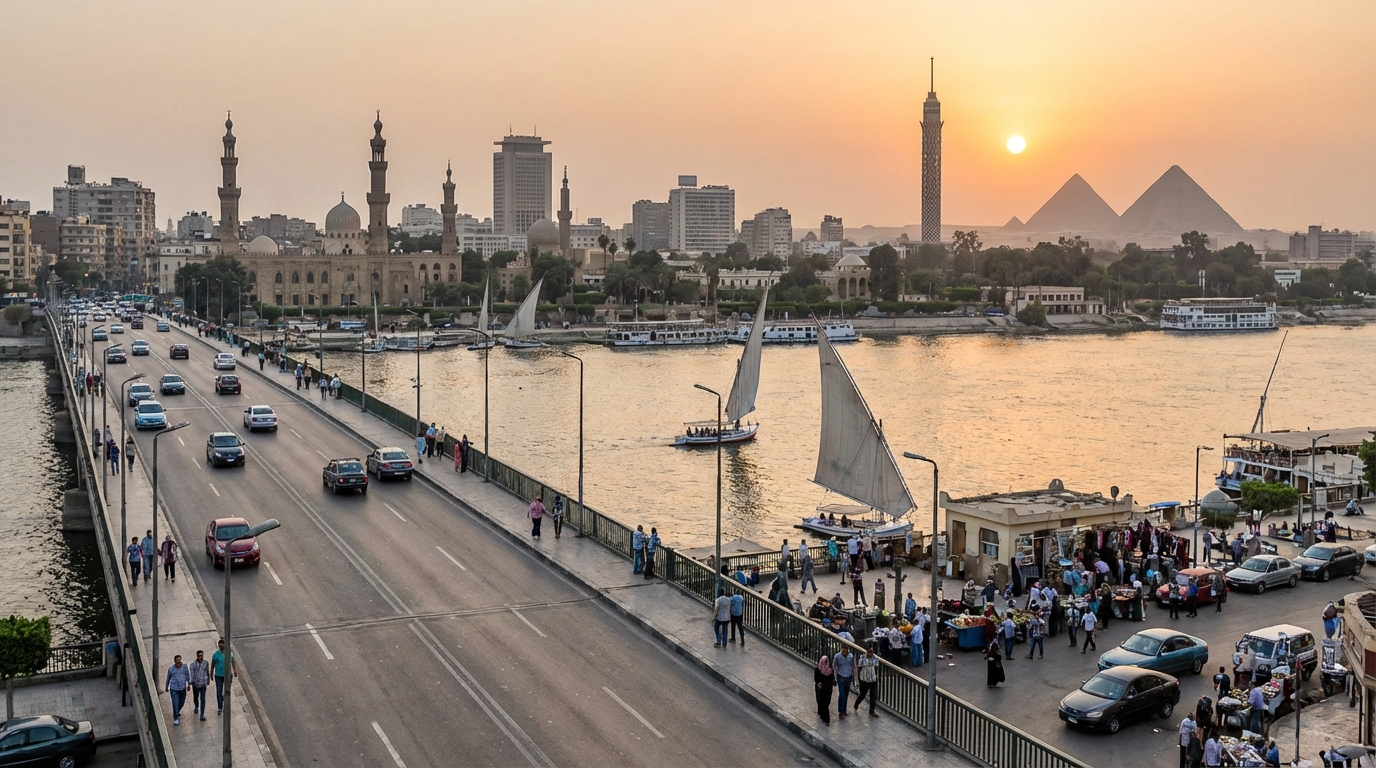
Cairo is a region of Egypt. Cairo spans the Nile’s banks where the Sahara meets the delta. It is characterized by the grit of desert dust and the 393.8-meter Iconic Tower rising over a landscape of 22 million residents.
Geography
The city occupies a narrow corridor between the Muqattam Hills and the Western Desert. It experiences a stark hyper-arid climate with only 25 millimeters of annual rainfall. The soil is composed of deep Nile silt, which supports 22 million people on less than 3% of Egypt's total land area, creating a density where buildings are often separated by mere inches.
History
In 969 AD, the Fatimid general Jawhar al-Siqilli began construction of a new royal enclosure. Tradition states that as the foundation stones were laid, the planet Mars—Al-Najm al-Qahir—reached its zenith. This celestial alignment led to the city being named Al-Qahira, or 'The Victorious.' This moment shifted the Islamic world's center from Baghdad to the Nile.
Landmarks
- Great Pyramid of Giza: The structure’s 2.3 million limestone blocks are aligned to true north with an accuracy of within three-sixtieths of a degree.
- Mosque of Sultan Hassan: Constructed in 1356, its soaring walls were built using stone stripped from the outer casing of the Giza pyramids.
- The Hanging Church: This 3rd-century sanctuary rests on two Roman gate towers; visitors look through floor panels to see the 13-meter drop below.
- Iconic Tower: Standing at 393.8 meters in the eastern desert, this glass obelisk was constructed using 18,000 tons of structural steel.
- Tahya Misr Bridge: Opened in 2019, this 67.3-meter-wide cable-stayed bridge holds a Guinness World Record and features a pedestrian glass walkway over the Nile.
Cuisine
Cairo’s food relies on the heavy, earthy scent of cumin and the texture of slow-cooked legumes. The city’s palate is defined by dry heat cooking and the use of copper vessels. A key technique is the tasha, a sizzle of garlic and coriander in ghee, providing the aromatic signature to most local stews.
- Koshary: A carb-heavy 19th-century street food combining Italian macaroni, Egyptian lentils, and rice, topped with a vinegar-heavy tomato sauce.
- Ful Medames: Fava beans simmered for 12 hours in narrow-necked copper qedras, resulting in a buttery texture seasoned with linseed oil and lemon.
- Molokhia: A viscous, dark green jute leaf soup that Caliph Al-Hakim banned in 1004 AD because he considered its texture too indulgent.
- Karkadeh: A deep crimson infusion of dried hibiscus petals, served chilled to provide a tart, astringent cooling effect against the 40°C heat.
- Asab: Fresh sugarcane stalks crushed through iron rollers, producing a pale green, frothy juice that must be drunk quickly before it oxidizes.
Culture
Life follows the rhythmic calls to prayer and the nocturnal shift of social life, where cafes remain occupied until 3:00 AM. Dress codes balance heat management with modesty, utilizing breathable cottons and loose silhouettes. Festivals often merge ancient agricultural cycles with religious calendars.
- Sham el-Nessim: Celebrated since 2700 BC, residents head to the Nile to eat salted fermented fish (fesikh) to mark the spring harvest.
- Mawlid an-Nabi: The city is decorated with sugar dolls and nut-based candies to celebrate the Prophet's birth, a tradition since the 10th century.
- Coptic Christmas: Celebrated on January 7, following a 43-day vegan fast, ending with a massive feast of meat and fatteh after midnight mass.
- Galabeya: A loose, floor-length cotton garment with wide sleeves, designed to facilitate airflow and maintain cool air around the skin.
- Melaia Laff: A heavy black silk wrap-around shawl traditionally worn by women, pinned to create a distinctive silhouette during movement.
- Taqiyah: A short, rounded cotton cap worn under turbans or alone, absorbing sweat during daily physical labor and prayer.
- Kaftan: A long, buttoned robe made of striped silk or wool, worn over the galabeya by the merchant class since the Ottoman era.
- Mandil bi-Oya: A headscarf edged with intricate, hand-crocheted lace flowers, used to signify marital status and regional identity in the 20th century.