Ahmedabad
Ahmedabad is a city in the Gujarat region of India. Ahmedabad sits at 23.02°N on the Sabarmati River banks in Gujarat, India. It is the first Indian city designated as a UNESCO World Heritage site due to its 600-year-old Pol housing clusters that utilize unique communal architectural planning.
Geography
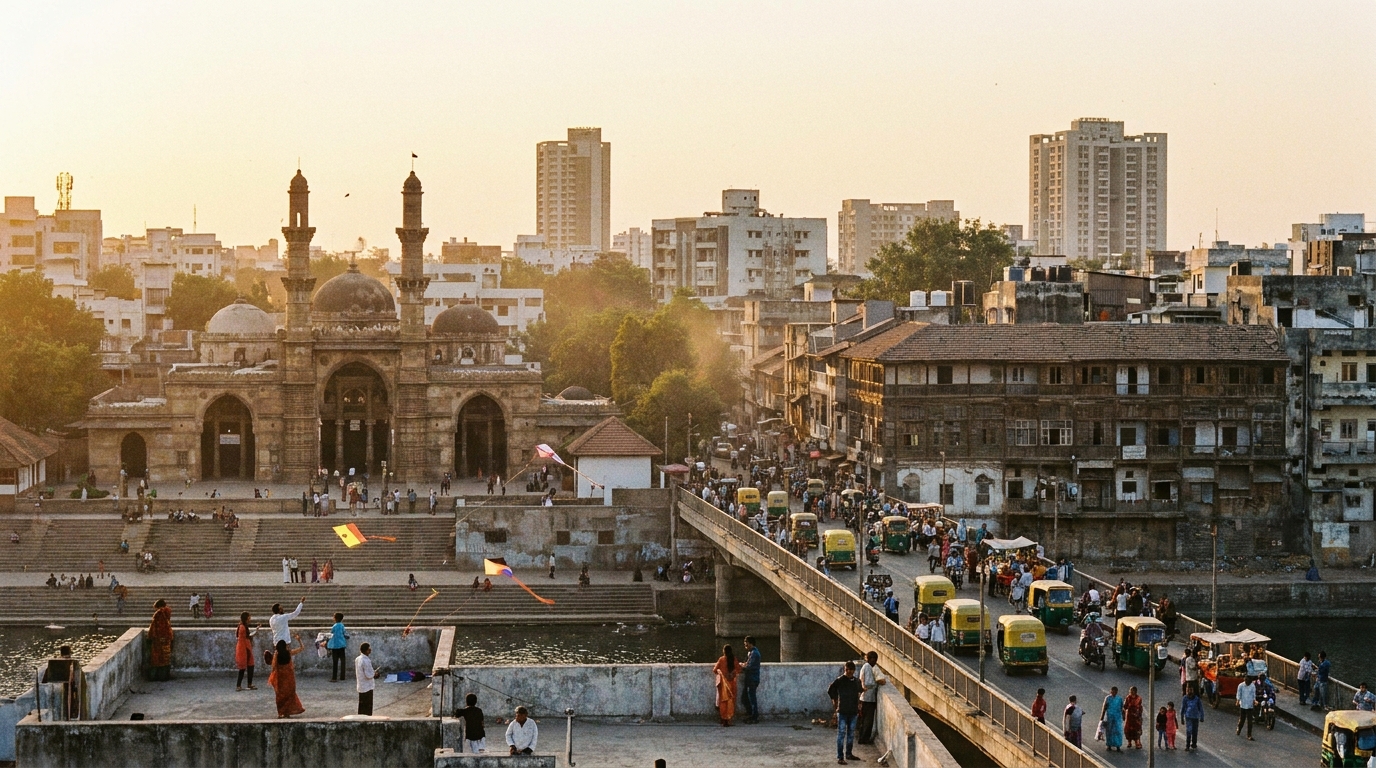
The city occupies a flat, 53-meter elevation plain where the Sabarmati River separates the 15th-century walled city from the 21st-century skyline. The soil is predominantly yellow sandy-alluvium. During May, temperatures reach 45°C, but the narrow, shared-wall Pol alleys use natural convection to drop local temperatures by 4 degrees.
History
On February 26, 1411, Sultan Ahmed Shah witnessed a rabbit chasing his hunting dog along the Sabarmati. Interpreting this as a sign of spiritual courage, he chose the site for his capital. This shifted power from nearby Ashaval, leading to the construction of twelve massive citadel gates that still regulate city traffic flow today.
Landmarks
- Sidi Saiyyed Mosque: Built in 1573, the Tree of Life window features complex floral geometry carved into yellow sandstone with zero visible joinery or cracks.
- Adalaj Stepwell: This 1498 five-story structure features underground octagonal openings that keep the air a constant 24°C even during peak summer heatwaves.
- Sabarmati Ashram: In this 1917 residence, the floors are polished with cow dung and clay, providing a cooling, antimicrobial surface for barefoot meditation.
- Atal Pedestrian Bridge: Completed in 2022, this 300-meter steel structure features 2,100 LED lights that change color based on the river's actual water depth.
- Amdavad ni Gufa: An underground gallery from 1994 with turtle-shell domes covered in broken white porcelain to reflect 90% of harsh solar radiation.
Cuisine
Ahmedabad's cuisine follows a strict vegetarian code, emphasizing a balance of sweet jaggery and sour lime. In the 600-year-old Pols, the day starts at 5:00 AM with the rhythmic sound of Thepla being rolled on stone boards.
- Dhokla: A 15-minute steamed fermented rice snack, finished with a 180°C oil temper of mustard seeds that creates a distinct popping sound.
- Khandvi: Two-centimeter wide rolls of gram flour and yogurt, spread thin on marble slabs before rolling, requiring exactly 10 minutes of cooking.
- Khichu: A warm, glutinous rice-flour dough seasoned with cumin and green chilies, served with a tablespoon of raw, pungent peanut oil.
- Masala Chass: Churned buttermilk with 5 grams of roasted cumin, served in clay pots to maintain a 15°C temperature during extreme heat.
- Piyush: A viscous, saffron-yellow blend of Shrikhand and buttermilk, so dense it takes 30 seconds to pour from a glass into a spoon.
Culture
Culture is defined by Pol living, where shared walls and narrow 2-meter lanes foster communal security. Traditional life revolves around the 180-day lunar calendar, dictating attire for the 9-day dance festivals and the January kite wars.
- Uttarayan: On Jan 14, 10 million kites fill the sky; the air smells of singed glass-coated string and sesame seeds roasted over charcoal.
- Navratri: For 9 nights in October, 5,000 dancers move in synchronized circles around a central clay lamp to a 4/4 drum beat.
- Rath Yatra: An 18-elephant procession hauls three 15-foot wooden chariots through 14 kilometers of the old city's narrowest 15th-century stone gates.
- Kediyu: A pleated, high-waisted men’s tunic for Garba, featuring 200 tiny mirrors that reflect light beams during rapid 360-degree spins.
- Chaniya Choli: A 3-piece women's outfit with a skirt using 12 meters of cotton, hand-printed with 18th-century block designs from nearby Pethapur.
- Kafni: Loose-fitting white cotton trousers worn by elder men; the 40-count fabric allows maximum evaporation in 90% monsoon humidity.
- Bandhani Dupatta: A 2.5-meter silk veil containing 10,000 hand-tied knots, dyed in indigo and madder root to signify family status and heritage.
- Koti: An embroidered waistcoat worn over kurtas, originally used by 19th-century merchants to hold brass coins in hidden inner pockets.