Kashgar
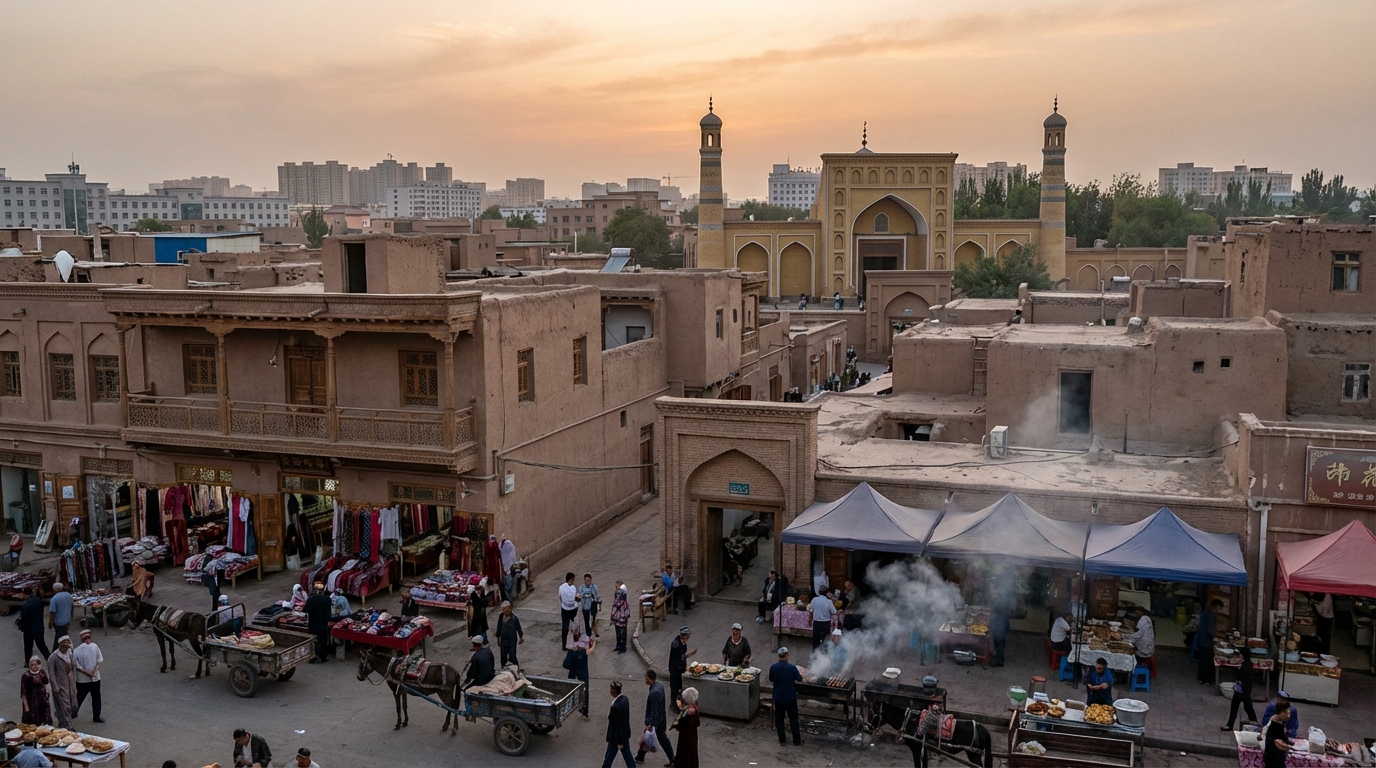
Kashgar is a city in the Xinjiang region of China. Kashgar sits at the westernmost edge of China, positioned at the precise intersection where the Taklamakan Desert meets the Pamir Mountains. This 2,000-year-old oasis remains the psychological heart of the Silk Road, defined by its intricate mud-brick architecture and the constant scent of cumin-spiced lamb drifting through 500-year-old marketplaces.
Geography
Located at 39.47°N, Kashgar occupies an oasis watered by the Kyzyl-Su river. The city experiences 200 frost-free days annually, creating a microclimate where pomegranate trees thrive despite the surrounding desert's 40°C summer heat. It sits closer to Kabul than to Beijing, functioning as a high-altitude gateway surrounded by peaks that exceed 7,000 meters.
History
In 1273, Marco Polo documented Kashgar's role as a merchant nexus. However, a pivotal shift occurred in 1884 when the Qing Dynasty formally incorporated the region as Xinjiang. This administrative change transformed Kashgar from a series of independent khanates into a strategic frontier city, forever altering its architectural and political trajectory during the 'Great Game' between empires.
Landmarks
- Id Kah Mosque: Built in 1442, its yellow-tiled courtyard holds 20,000 worshippers; the acoustics are designed so a whisper carries across the entire prayer hall.
- Afāq Khoja Mausoleum: This 1640 structure features 58 different patterns of green glazed tiles, reflecting the 17th-century Sufi influence on local architectural aesthetics and burial traditions.
- Ancient City of Kashgar: Reconstructed using seismic-resistant traditional methods, these mud-brick alleys sit atop layers of continuous human habitation dating back to the Han Dynasty.
- Ancient City Corner Tea House: A century-old social hub where elders sit on carpets, sipping tea while playing the Rawap under hand-carved poplar ceilings for hours.
- The New Night Market: A 2010s development lighting up with 1,000 lanterns, focusing on contemporary fusion street snacks like grilled eggs flavored with honey and saffron.
Cuisine
The kitchen centers on the 'tonur' (clay oven), reaching 400°C to sear dough. Local fat-tailed sheep provide a specific rendered tallow used in most recipes, creating a distinct flavor profile that separates Kashgar from eastern Chinese styles.
- Girde Nang: A thick-rimmed bread resembling a bagel; it must be broken by hand, never cut, and is traditionally dipped in hot salt water.
- Mutton Polo: Slow-cooked in cast-iron pots since the 10th century, using yellow carrots, mutton fat, and raisins for a sweet-savory balance.
- Willow Skewers: Lamb seasoned with cumin and red pepper, skewered on desert willow sticks that release a distinct smoky aroma when grilled over charcoal.
- Medicinal Herbal Tea: A hot blend of saffron, cardamom, and clove, sold by vendors who measure ingredients using antique brass scales for digestive health.
- Dogh: A summer staple consisting of shaved ice mixed with fresh yogurt and honey, served in ceramic bowls to maintain a frosty temperature.
Culture
Life moves to the rhythm of the 'Doppa' hat and the 'Muqam' musical suites. Since 2010, the Ancient City Opening Ceremony at 10:30 AM daily has become a community-led ritual involving traditional dancers and long-necked trumpets.
- Nowruz: Celebrated on March 21st, marking the spring equinox with communal porridge and 'Dawaz' tightrope walking performances 30 meters above the ground.
- Eid al-Fitr Sama Dance: Thousands gather at the main square for a rhythmic, circular dance performed to the rapid-fire beat of Sunay drums and bronze cymbals.
- Pomegranate Festival: Held in October in nearby orchards, celebrating the harvest with fruit-heavy displays and traditional wrestling matches held in dusty outdoor arenas.
- Badam Doppa: A four-cornered skullcap embroidered with almond motifs; the specific stitching density often identifies the wearer's home district or social status.
- Etles Silk: Hand-loomed since the 15th century, these dresses feature ikat patterns in crimson and gold, traditionally worn during summer wedding celebrations.
- Quilted Chapan: A heavy outer coat lined with cotton batting, designed to protect the wearer from sub-zero winds blowing off the Pamir plateau.
- Leather Turn-up Boots: Footwear with distinctive curved toes, designed originally to prevent sand from entering the boot while riding horses through the desert.
- Ornek Jewelry: Silver necklaces inlaid with carnelian, worn by women to protect against the 'evil eye' and represent family lineage through specific engravings.