Yining
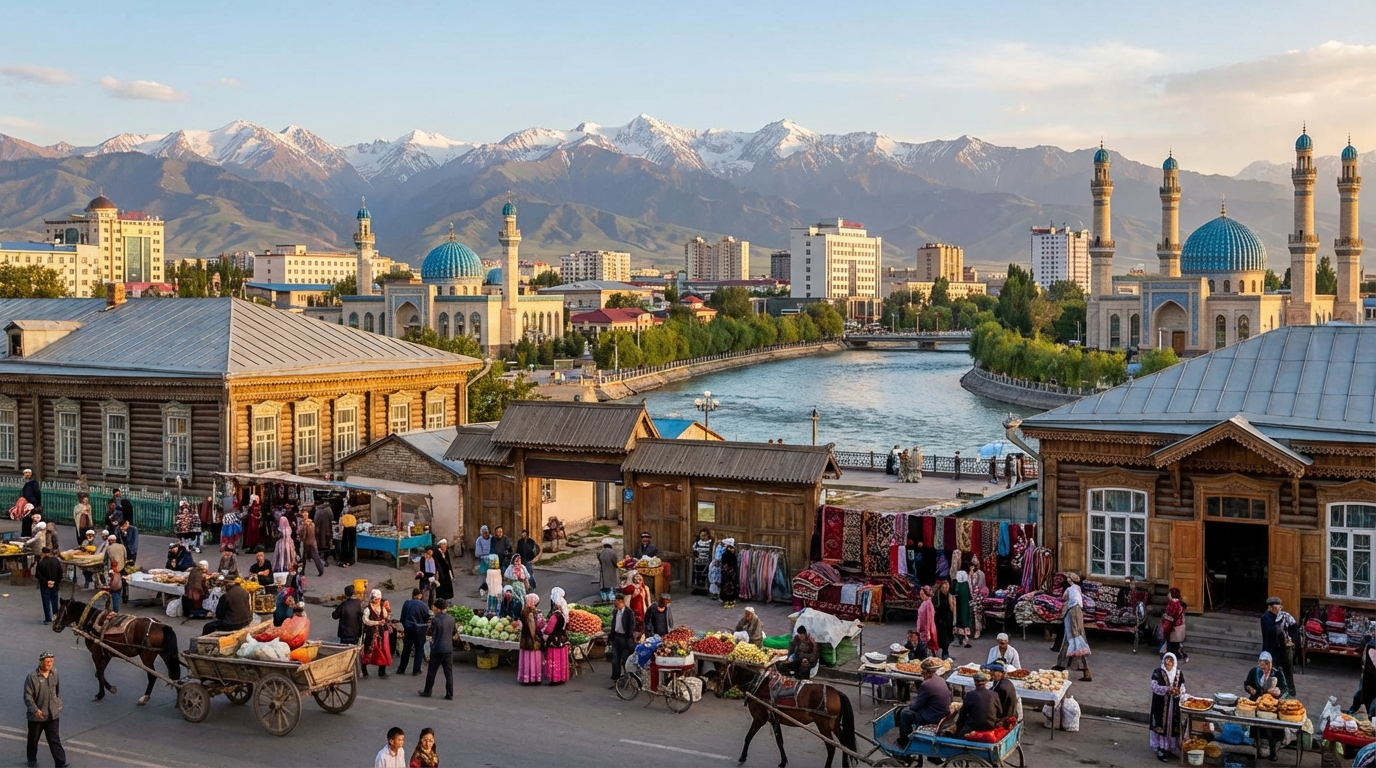
Yining is a city in the Xinjiang region of China. Yining, the administrative heart of the Ili Kazakh Autonomous Prefecture, serves as a high-altitude garden city nestled within the fertile Ili River valley near the Kazakhstan border. It is defined by its cooling Tianshan mountain breezes and a distinctive landscape of deep blue-painted architecture that reflects the sky.
Geography
At 43.9 degrees north, Yining occupies a rare moisture-rich pocket in an arid region. The Ili River is unique in China for flowing westward, delivering 16 billion cubic meters of annual runoff. This creates a temperate microclimate with 60 percent humidity, sustaining massive apricot forests and lush meadows that contrast sharply with the surrounding Taklamakan desert sands.
History
In 1762, the Qing dynasty established the Nine Cities of Ili to secure the western frontier. General Mingrui supervised the construction of Ningyuan, the precursor to modern Yining, as a fortified commercial hub. This strategic move successfully integrated diverse Silk Road merchants, creating a permanent trade link between the interior of China and the Central Asian khanates.
Landmarks
- Liuxing Street: A 1930s hexagonal grid designed by a German engineer to prevent dead ends and facilitate communal social interactions.
- Kazanqi Folk Village: Features houses painted in Ili Blue, a specific mineral-based pigment used for generations to lower indoor temperatures and deter insects.
- Bayandai Village Apricots: Home to 100-year-old fruit trees that create a thick canopy of pale pink petals every April during the flowering season.
- Ili River Bridge: A gathering point at sunset where temperatures drop 5 degrees Celsius, making it the primary site for local wedding photography.
- Stalin Street Balconies: Early 20th-century Russian-style wrought iron lattices and heavy wooden shutters designed to provide insulation against harsh Tianshan winter winds.
Cuisine
The cuisine relies on stone-ground wheat and high-fat mutton from valley-raised sheep. Preparation centers around the tonur, a clay oven that reaches 300 degrees Celsius, allowing meat to sear while bread dough adheres to the walls, absorbing the smoke.
- Ili Horse Sausage: Rib meat and fat seasoned with black pepper, stuffed into casings and cold-smoked over pine wood for 24 hours.
- Yellow Carrot Polu: Rice slow-cooked with indigenous yellow carrots and mutton fat, resulting in a distinctively sweet and savory profile compared to red-carrot variants.
- Narin Noodles: Hand-cut thin noodles served with finely shredded horse meat and a hot onion-pepper broth, usually eaten communally from large platters.
- Honey Kvass: A fermented rye bread beverage with 0.5 percent alcohol, flavored with local honey and served chilled from large street barrels.
- Etken Chay: Salty brick tea boiled with fresh cow's milk and enriched with a dollop of thick local cream for breakfast energy.
Culture
The culture is anchored by the Meshrep, a formal community gathering that regulates social behavior through music and humor. Residents predominantly use the Ili dialect, which incorporates Russian and Kazakh loanwords reflecting their frontier history.
- Nowruz: Celebrated on March 21 with the cooking of seven-ingredient porridge to mark the spring equinox and the start of farming.
- Apricot Blossom Festival: An April event where locals recite poetry and play the two-stringed dombra under the blooming white and pink trees.
- Kurban Eid Sama Dance: A major celebration featuring the rhythmic Sama dance, where hundreds of men perform synchronized movements in the city's public squares.
- Badam Doppa: A four-cornered skullcap embroidered with almond-shaped motifs, symbolizing fertility and protection for the wearer's mind during daily work.
- Quilted Chapan: A heavy silk or cotton outer robe with high collars, designed to protect the wearer from the piercing Tianshan winds.
- Ruffled Koynek: A lightweight silk dress for women featuring multi-layered hems, historically worn over trousers to allow for comfortable horse riding.
- Fox-fur Tumak: A traditional Kazakh winter hat made from thick fur with adjustable flaps that tie under the chin for sub-zero protection.
- Silver Eteksiz: A ceremonial vest adorned with authentic silver coins that create a melodic jingling sound during traditional folk dance performances.