Kochi
Kochi is a city in the Kerala region of India. Located on India's Malabar Coast, Kochi is a sprawling archipelago where the salt-heavy air of the Laccadive Sea meets the scent of fermenting spices. The city’s identity was forged in 1341 when a catastrophic flood rearranged the coastline, creating a natural harbor that replaced the ancient port of Muziris.
Geography
Kochi sits at sea level on the edge of the Vembanad Lake, India’s longest lake system. The terrain is a complex network of brackish lagoons and tidal canals where humidity often hits 90% during the monsoon season. A pivotal flood in 1341 silted the mouth of the Periyar River, simultaneously destroying a prehistoric trade center and birthing Kochi's deep-water basin.
History
In 1341, massive flooding of the Periyar River carved out the Kochi harbor, transforming a small fishing village into a strategic maritime hub. This geological shift invited the Portuguese in 1503, led by Admiral Afonso de Albuquerque, who established Fort Emmanuel. This site became the first European settlement in India, marking a 500-year era of colonial interaction.
Landmarks
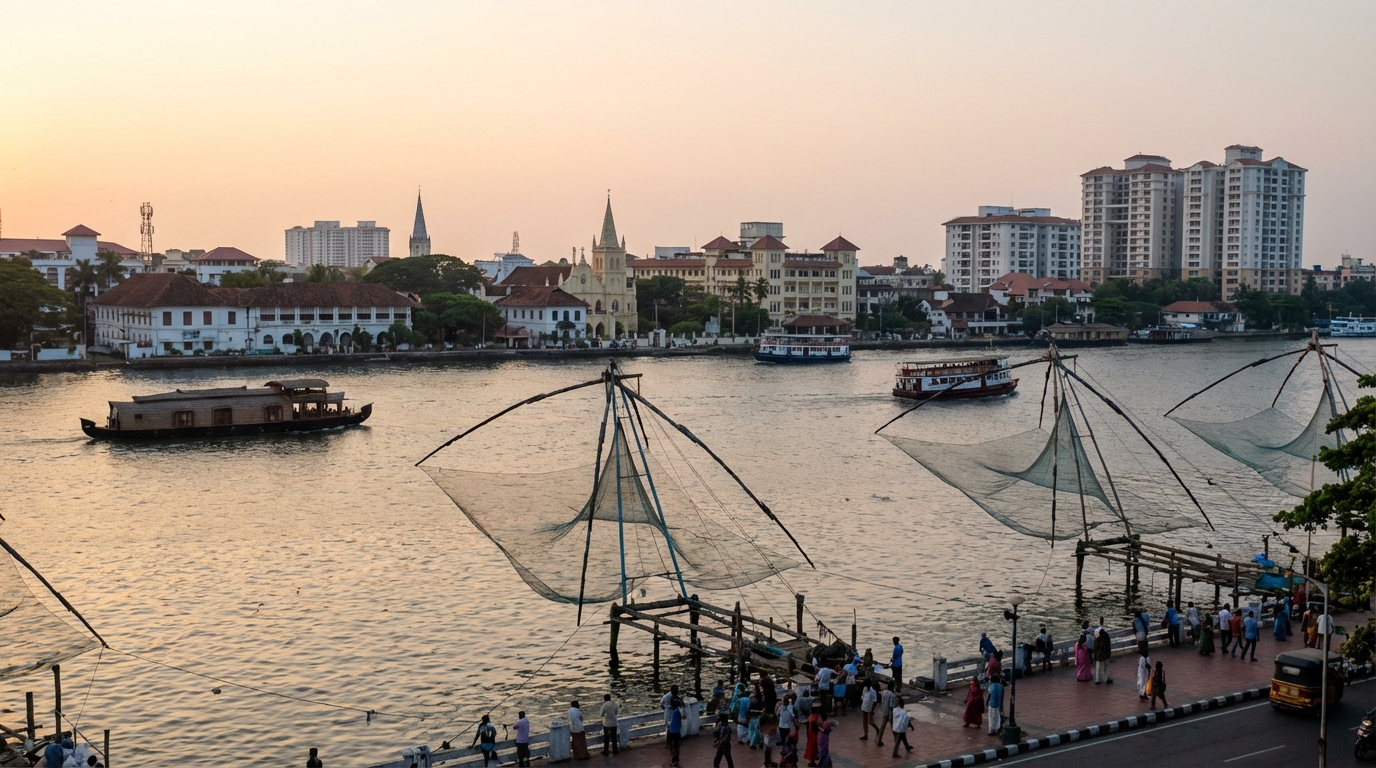
- Chinese Fishing Nets: These 10-meter-high teak structures use granite boulders as counterweights to lift nets from the silt-heavy estuary waters using ancient cantilever principles.
- Paradesi Synagogue: The floor is paved with hundreds of hand-painted porcelain tiles from Canton, China, imported in 1762, each featuring a unique blue willow pattern.
- St. Francis Church: Built in 1503, this limestone structure originally held Vasco da Gama's remains for 14 years before they were repatriated to Lisbon in 1539.
- Kochi Water Metro: Launched in 2023, this is a fleet of 23 battery-powered electric boats that navigate the backwaters using silent, emission-free underwater-cabled navigation.
- Aspinwall House: A heritage sea-facing bungalow that serves as the primary venue for the Kochi-Muziris Biennale, hosting massive contemporary installations in its weathered colonial rooms.
Cuisine
The kitchen is a laboratory for coconut in three forms: grated, milked, and oil-fried. Local flavors are defined by black pepper from the Western Ghats and the aggressive tempering of mustard seeds in hot iron pans.
- Karimeen Pollichathu: Pearl spot fish rubbed in bird's eye chili paste, wrapped in a wilted banana leaf, and pan-seared until the leaf chars and infuses smoke.
- Appam with Stew: Fermented rice pancakes with crispy, lacey edges and a soft center, paired with a coconut milk gravy simmered with cinnamon and cloves.
- Puttu and Kadala Curry: Steamed cylinders of rice flour and coconut shavings, served with a dark, spicy black chickpea curry flavored with roasted coconut and ginger.
- Sambharam: Chilled buttermilk churned with crushed ginger, green chilies, and curry leaves, traditionally served in clay pots to maintain a 15-degree temperature.
- Kulukki Sarbath: A shaken lemonade containing soaked basil seeds and a split green chili, violently agitated in a glass to balance heat with sugar.
Culture
Life revolves around the 'Mundu' and the rhythmic 'Chenda' drumming. The city transitions from traditional Kathakali performances to the Kochi-Muziris Biennale, India’s largest contemporary art festival.
- Cochin Carnival: Held every December at Fort Kochi, featuring a massive burning of 'Pappanji', a 30-foot tall old man effigy, at midnight to welcome the New Year.
- Attachamayam: A street parade in Tripunithura marking Onam's start, featuring elephant processions, Pulikali tiger dancers, and performers depicting 12th-century royalty.
- Kochi-Muziris Biennale: An international contemporary art exhibition held every two years across 14 heritage venues, drawing over 600,000 visitors to the city's historic quarters.
- Kasavu Mundu: A cream-colored handwoven cotton wrap with a 2-inch gold zari border, worn by men for temple ceremonies and formal occasions.
- Set Mundu: A two-piece garment mimicking a saree, made of starched white cotton with gold borders, reflecting the aesthetic of Kerala's ancient clothing.
- Kallu Mundu: A casual, colored cotton wrap often featuring checkered patterns, worn by fishermen and local workers for daily utility in high humidity.
- Chatta and Mundu: A traditional white V-neck blouse and wrap featuring a fan-like pleat at the back, worn by older Syrian Christian women.
- Kathakali Vesham: A ceremonial performance costume including 10-kilogram wooden headgear and multifaceted makeup made from rice paste and natural mineral pigments.