Munnar
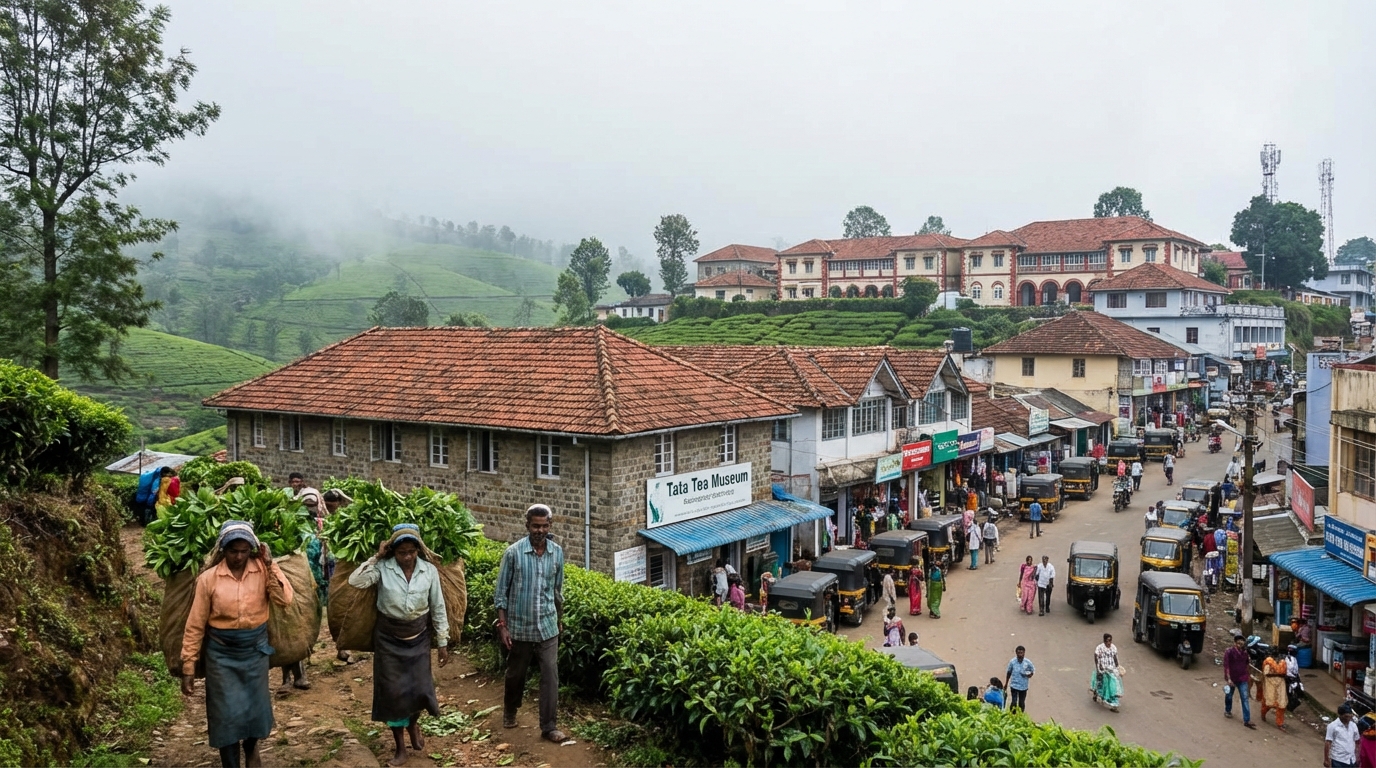
Munnar is a city in the Kerala region of India. Munnar sits at 1,600 meters above sea level in the Idukki district of Kerala, where three mountain streams—Muthirapuzha, Nallathanni, and Kundaly—merge into a single flow. The landscape is defined by 24,000 hectares of tea shrubbery that resembles a tight-knit green velvet carpet draped over the jagged Western Ghats.
Geography
The terrain features Anamudi, the highest peak in South India at 2,695 meters, often shrouded in a thick mist that smells of damp earth. The microclimate is characterized by a 12-year cycle for the Neelakurinji flower to bloom, and winter temperatures frequently drop to 0°C, causing a thin layer of frost to coat the tea leaves.
History
In 1877, John Daniel Munro leased 580 square kilometers from the Poonjar Royal Family for an annual rent of 3,000 rupees. While he initially attempted to grow coffee, the devastating leaf disease of 1895 forced a pivot to tea, led by James Finlay and Company, permanently carving the iconic geometric grids into the wild mountain slopes.
Landmarks
- Eravikulam National Park: Home to the Nilgiri Tahr; exactly 750 of these mountain goats with curved horns graze on the steep, wind-swept grasslands above the treeline.
- Tea Museum at Nallathanni: Displays a 1913 Pelton wheel from a local power house and original wooden bathtubs used by early Scottish tea planters in the high ranges.
- Mattupetty Dam: A 170-meter high masonry gravity dam where the echo point produces a three-second delay as sound waves bounce off the surrounding granite hills.
- Punarjani Traditional Village: Locals gather here at 5 PM daily to witness Kathakali dancers apply crushed stones for pigment, a process taking over three hours of preparation.
- Mount Carmel Church: Established in 1898, this hilltop structure contains tombstones of early pioneers who died during the Great Flood of 1924 that reshaped the valley.
Cuisine
The diet centers around 'Malnad' spices, using hand-ground black pepper and cardamom harvested from the Shola forests. Wood-fired kitchens are common, imparting a smoky aroma to every meal, while the altitude dictates a preference for calorie-dense, fermented rice dishes.
- Puttu and Kadala Curry: Steamed rice cylinders layered with coconut, served with black chickpeas simmered in a gravy of 12 toasted spices including star anise and fennel.
- Nadan Kozhi Varuthathu: Chicken marinated in ginger-garlic paste and deep-fried in local coconut oil until the skin becomes brittle, dark crimson, and intensely aromatic.
- Kallu Appam: Fermented rice pancakes with lace-like edges and a spongy center, traditionally leavened using naturally fermented coconut sap to provide a slight tang.
- Estate Cardamom Tea: Freshly plucked 'Broken Orange Pekoe' leaves steeped with crushed green cardamom pods, usually consumed at 4 PM as the evening mist rolls in.
- Chukku Vellam: Dry ginger water boiled with cumin seeds, served piping hot to counteract the 12°C evening chill and aid digestion after spicy meals.
Culture
Life revolves around the 'Layams' or plantation quarters where Malayalam and Tamil traditions blend. The cultural calendar is strictly dictated by the tea-plucking seasons and the heavy southwest monsoon rains that dominate the high-altitude lifestyle.
- Onam in the Estates: Plantation workers create 'Pookalam' floral carpets using wild lantana and marigolds found on the hillsides to welcome the mythical King Mahabali.
- Deepavali: Celebrated with intensity by the Tamil migrant community; oil lamps are placed along the tea-row edges, creating a flickering golden grid at night.
- Attukal Pongala: Local women cook rice and jaggery in earthen pots over open wood fires near the temples, a ritual signifying patience and shared community.
- Mundu: A 4-meter long white cotton cloth wrapped around the waist, essential for men navigating the humid lower valleys near the riverbanks.
- Kasavu Saree: Cream-colored silk with a gold zari border, worn by women during temple visits and the 'Thiruvathira' dance performances under the full moon.
- Thorthu: A thin, absorbent cotton towel tied as a turban by estate workers to soak up moisture and rain during the eight-hour plucking shifts.
- Settu Mundu: A two-piece garment providing the elegance of a saree but with the mobility needed to climb the uneven, 30-degree plantation slopes.
- Coarse Woolen Shawl: A heavy, dark-colored wrap used by tea pluckers during the December frost months when temperatures frequently hover near freezing at sunrise.