Kanyakumari
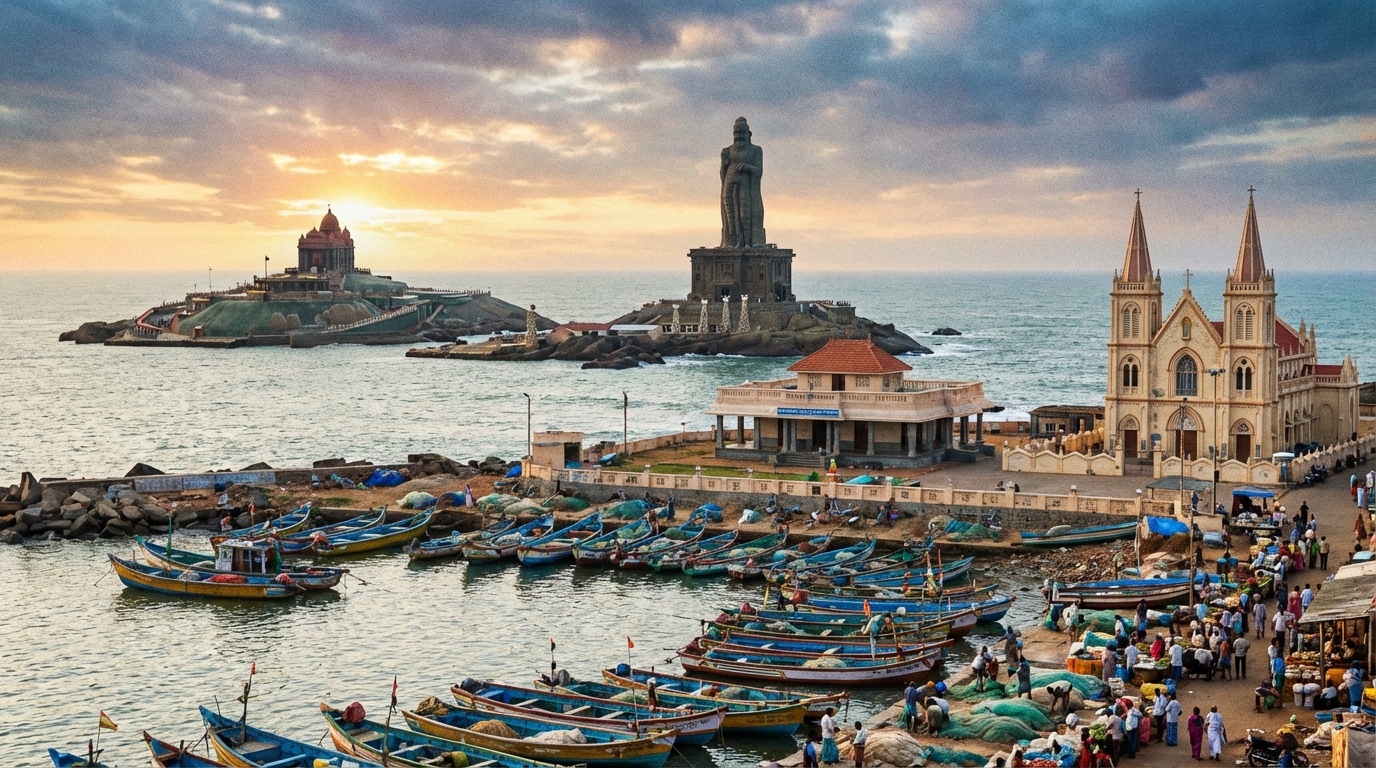
Kanyakumari is a city in the Tamil Nadu region of India. Kanyakumari sits at the southern tip of the Indian peninsula where the Arabian Sea, Bay of Bengal, and Indian Ocean collide. It is the only place in India where the sun rises and sets over the same horizon during a full moon.
Geography
Situated at 8.0883° N, the town rests on multi-colored sands—red, yellow, and black—caused by monazite deposits. The air carries a heavy salt mist that corrodes iron within months, while the wind speeds often reach 30 km/h due to the converging maritime thermal gradients.
History
In 1956, the States Reorganisation Act marked a turning point when Kanyakumari officially merged with Tamil Nadu. This followed a decade of civil advocacy led by Marshal A. Nesamony, who mobilized thousands to ensure the district’s linguistic and cultural alignment with its Tamil-speaking neighbors.
Landmarks
- Vivekananda Rock Memorial: Built in 1970, this granite structure sits on a 15-meter pedestal where salt spray coats the red Chithira stone continuously.
- Thiruvalluvar Statue: This 133-foot stone figure weighs 7,000 tons and symbolizes 133 chapters of the Tirukkural, braving high-velocity winds and ocean currents.
- Padmanabhapuram Palace: Constructed around 1601, the floors use a mixture of burnt coconut shells, egg whites, and lime, remaining cold and polished black.
- Circular Fort (Vattakottai): An 18th-century granite fortification where the ramparts overlook black sand beaches and the meeting point of three distinct maritime currents.
- Mathur Aqueduct: Completed in 1966, this 1,240-foot bridge carries irrigation water 115 feet above the Pahrali River, supported by 28 massive stone pillars.
Cuisine
Seafood is dominated by the Nanjil style, utilizing small Chala fish and heavy amounts of coconut roasted until dark brown and aromatic.
- Nanjil Fish Curry: Cooked in clay pots with Malabar tamarind, this curry develops a sharp, smoky tang after resting for exactly six hours.
- Aval with Matti Banana: A breakfast served on palm leaves, combining red rice flakes with local Matti variety bananas and dark palm jaggery.
- Ulunthu Kali: A dense, dark gray pudding made from black gram and sesame oil, traditionally served to teenagers for strengthening bone marrow.
- Nungu Sarbath: A cooling summer drink using the translucent, jelly-like flesh of the palmyra fruit mixed with Sarsaparilla syrup and lime juice.
- Sukku Kaapi: A dry ginger coffee infused with black pepper and palm jaggery, used to combat the humid evening chills of the monsoon.
Culture
The culture is a hybrid of Tamil and Malayali influences, reflected in the prevalence of white cotton attire and the 10-day Chithira Pournami festival.
- Suchindrum Margazhi Festival: Held in December, three massive wooden chariots, the tallest being 44 feet, are pulled through the streets by hundreds of devotees.
- Cape Comorin Festival: A three-day October event where classical dancers perform against the sound of crashing waves, celebrating the confluence of three seas.
- St. Mary’s Church Feast: An 11-day September celebration featuring a gold-plated palanquin procession, reflecting the region's 400-year-old Christian heritage.
- Mundum Neriyathum: A two-piece white cotton garment with a gold border, worn by women during temple visits and formal weddings.
- Kasavu Mundu: A white rectangular cloth with a gold zari border wrapped around the waist by men for formal religious ceremonies.
- Nanchinadu Saree: Distinctive for its minimalist border, these handloom sarees are woven in Agastheeswaram using specific high-twist cotton yarns.
- Thorthu: A thin, absorbent white cotton towel used as a head-wrap by local fishermen to protect against the 32°C midday sun.
- Pattu Pavadai: A silk skirt and blouse set worn by young girls, typically featuring traditional peacock motifs in temple jewelry colors.