Tamil Nadu
Tamil Nadu is a region of India. Tamil Nadu sits at the southernmost tip of the Indian peninsula, defined by the 1,076 km Coromandel Coast and a 2,000-year-old linguistic heritage. It is the only place on earth where the classical Tamil language has been spoken continuously from antiquity to the modern digital age.
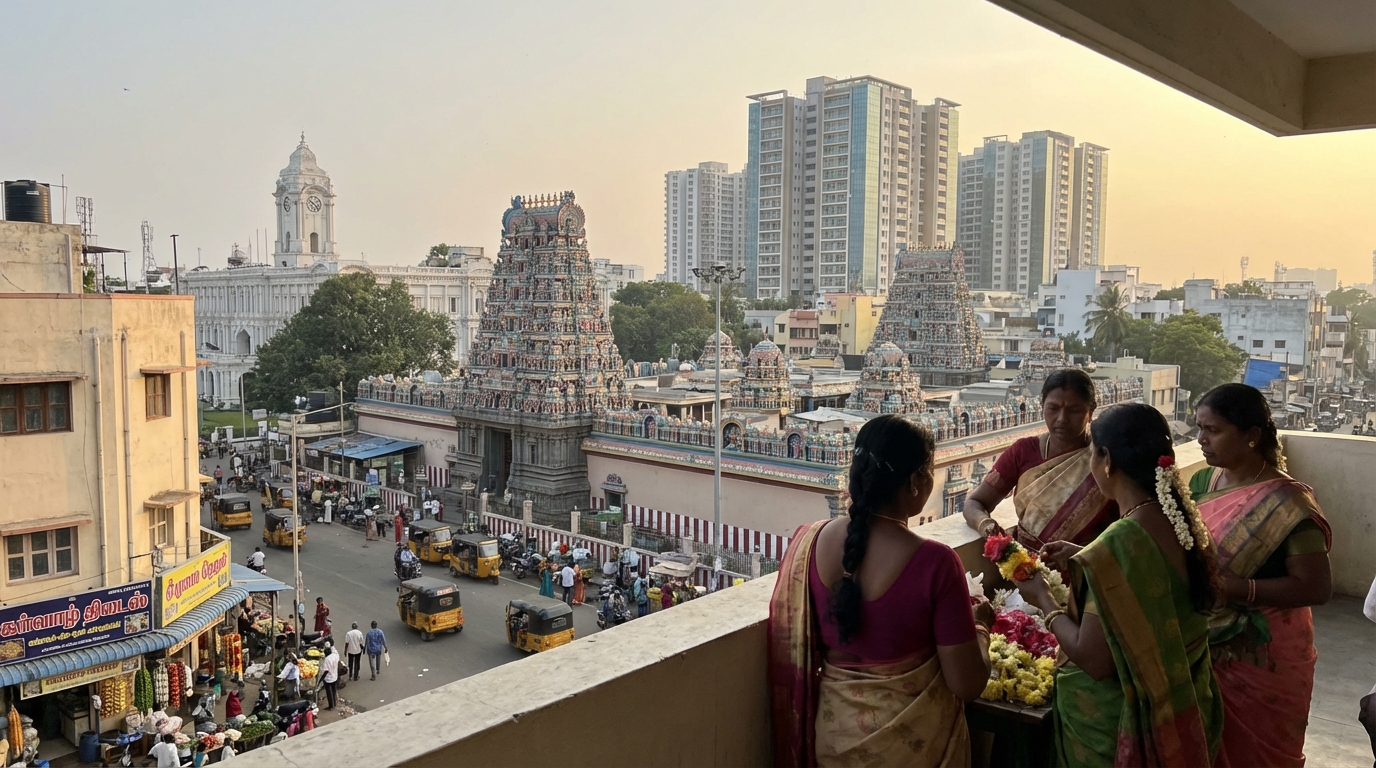
Geography
The state is divided by the 30 km wide Palghat Gap in the Western Ghats, which allows cool maritime air to reach the interior. Unlike most of India, Tamil Nadu receives 48% of its water from the retreating Northeast Monsoon between October and December.
History
On January 14, 1969, Chief Minister C.N. Annadurai officially renamed Madras State to Tamil Nadu. This pivotal moment transformed the region from a colonial administrative unit into a state defined by its 5th-century Sangam literary roots and Dravidian identity.
Landmarks
- Brihadisvara Temple: The 81.3-tonne granite capstone was moved to the top of the 66-meter tower in 1010 CE using a 6-km long earthen inclined ramp.
- Meenakshi Amman Temple: This complex features 14 gopurams covered in 33,000 polychrome stone sculptures of deities and mythical animals, repainted every 12 years by traditional artisans.
- Vivekananda Rock Memorial: Constructed in 1970 on a small offshore island, this granite structure marks the confluence of the Arabian Sea, Bay of Bengal, and Indian Ocean.
- Pamban Bridge: Opened in 1914, this 2.06 km sea bridge uses a manual Scherzer rolling lift mechanism that splits the tracks to let ships pass through.
- Auroville Matrimandir: Completed in 2008, this geodesic dome is covered in 1,415 gold-leaf discs and contains a 70 cm diameter optically perfect crystal ball.
Cuisine
Tamil cooking utilizes the 12-hour fermentation of rice and black gram lentils to create lactic acid bacteria for gut health. Dishes are traditionally seasoned with 'Kalpasi' or stone flower, a lichen that adds a distinct woody aroma.
- Chettinad Chicken: Prepared with 23 spices including star anise and Maratti Mokku, toasted on iron pans to create a dark, intensely pungent and earthy flavor profile.
- Dindigul Biryani: Uses 'Seeraga Samba' rice—ovate grains resembling cumin seeds—which absorbs the fat and juices of local short-grain fed goats better than long-grain Basmati.
- Paniyaram: Fermented batter is steam-fried in a heavy cast-iron 'Kuzhi' pan with seven spherical cavities, resulting in a crisp crust and a tangy, airy center.
- Filter Coffee: Brewed in brass percolators with an 80:20 coffee-to-chicory ratio, then 'pulled' through the air to create a natural, thick froth without steam.
- Panakam: A traditional 1st-century cooler made from palm jaggery, crushed black pepper, and dried ginger, specifically served during the 40-degree Celsius heat of April.
Culture
Culture revolves around 'Iyal', 'Isai', and 'Natakam'. Men wear unstitched cotton veshtis, while women wear Kanchipuram silks featuring real silver-gold zari threads and temple-inspired patterns.
- Pongal: A four-day harvest festival starting January 14th where rice is boiled in clay pots until it overflows, signaling prosperity and solar gratitude.
- Jallikattu: A 2,000-year-old bull-embracing event where participants attempt to hold the hump of a Pulikulam bull for 15 meters to claim ceremonial prizes.
- Margazhi Festival: A 30-day winter season in Chennai featuring over 1,500 performances of Carnatic music and Bharatanatyam dance in traditional sabhas across the city.
- Kanchipuram Saree: Hand-loomed silk where the border and body are joined by a 'Petni' stitch, often containing 57% silver and 0.6% real gold.
- Veshti: A 4-meter white cotton rectangular cloth wrapped around the waist, secured with a specific double-tuck for formal temple and wedding attendance.
- Angavastram: A rectangular shoulder cloth with a gold border, draped over the left shoulder by men to signify social status and ritual purity.
- Pavadai Sattai: A traditional two-piece garment for girls consisting of a long pleated silk skirt and a matching blouse, typically worn during puberty ceremonies.
- Madisar: A 9-yard saree draped in a complex style that mimics trousers, traditionally worn by married Brahmin women during significant life rituals.