Madurai
Madurai is a city in the Tamil Nadu region of India. Located on the banks of the Vaigai River in southern Tamil Nadu, Madurai is an ancient settlement designed in the shape of a lotus with the Meenakshi Temple at its core. The city is the geographical heart of Tamil identity, smelling of crushed jasmine and sandalwood incense.
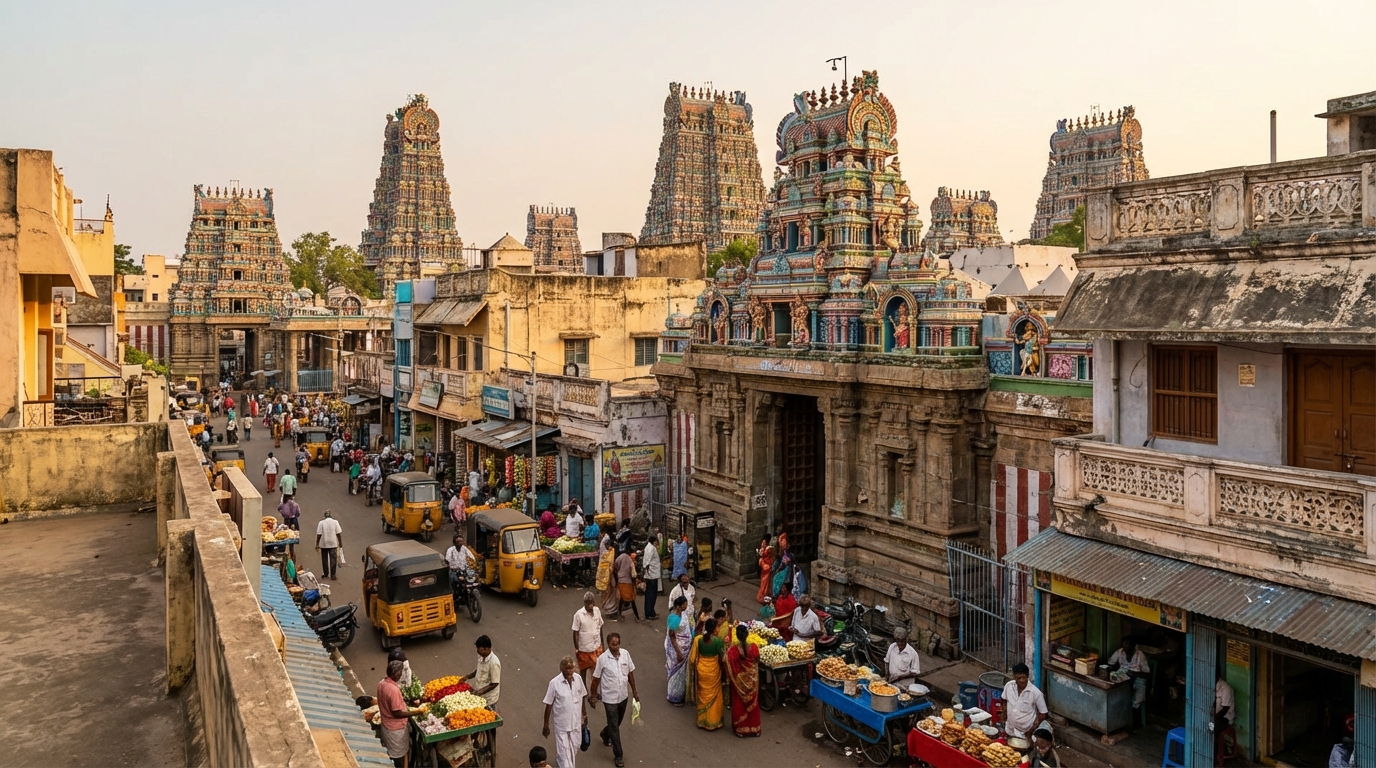
Geography
The city sits 101 meters above sea level on an alluvial plain. It is guarded by three granite hillocks: Yanaimalai, Nagamalai, and Pasumalai. The red soil remains parched as summer temperatures reach 42°C, while the Vaigai River typically appears as a dry, sandy expanse for 300 days a year.
History
In 1371, Kumara Kampana of the Vijayanagara Empire defeated the Madurai Sultanate. This pivotal victory led to the reopening of the Meenakshi temple's inner sanctum, which had been sealed with a stone wall for 48 years. This event triggered a massive architectural revival that defined the city's current skyline.
Landmarks
- Meenakshi Amman Temple: The 'Hall of Thousand Pillars' actually contains 985 uniquely carved granite columns that produce distinct musical notes when tapped.
- Thirumalai Nayakkar Mahal: Built in 1636, the palace's 248 massive white pillars were constructed using a mixture of egg whites and lime for a smooth finish.
- Gandhi Memorial Museum: This 17th-century palace houses the original blood-stained garment worn by Mahatma Gandhi during his assassination in 1948.
- Yanaimalai (Elephant Hill): A 3-kilometer long metamorphic rock formation shaped like a seated elephant, featuring 8th-century Jain bas-relief sculptures carved directly into its caves.
- Madurai Eco Park: This modern site features 100-foot tall illuminated musical fountains and artificial trees fitted with optical fiber lighting for nighttime displays.
Cuisine
Madurai's culinary identity is defined by hand-ground spices and gingelly oil. Street vendors dominate the night, rhythmically slapping dough on hot iron griddles. Mutton is a staple even at breakfast, often served as a spicy gravy with steamed idlis before the morning sun gets too high.
- Bun Parotta: A thick, multi-layered bread made from egg-enriched flour, fried until the outside is golden-crunchy while the inside remains soft.
- Kari Dosai: A heavy three-layered pancake consisting of a dosa base, a coating of beaten eggs, and a topping of spicy minced mutton.
- Idli with Chutney: Steamed in cloth-lined plates for a porous texture, these are served with a set of four distinct chutneys: coconut, tomato, mint, and ginger.
- Jigarthanda: A cooling mixture of almond resin, sarsaparilla syrup, and chilled milk, topped with a scoop of thick basundi cream.
- Paruthi Paal: A nutty, warm beverage brewed from cottonseed milk, raw sugar, and cardamom, traditionally served as a health tonic at sunset.
Culture
The local culture revolves around the 'Madurai Malli' jasmine, which has a geographical indication tag for its thick petals. Life is dictated by the 10-day Chithirai festival cycles. Men often wear white veshtis with gold borders, while the local dialect is known for its sharp, honorific-heavy grammar.
- Chithirai Festival: A massive April celebration reenacting the wedding of Goddess Meenakshi, drawing one million people to witness the golden chariot processions.
- Jallikattu: Held in January during Pongal, this ancient bull-embracing event in nearby Alanganallur tests the bravery of youths against native Kangayam bulls.
- Teppam Festival: Deities are placed on a massive illuminated float in the 16-acre Mariamman Teppakulam tank during the full moon of the Thai month.
- Madurai Chungadi Saree: Hand-dyed cotton sarees using wax-resist techniques, featuring tiny knotted patterns and borders inspired by temple architecture.
- Veshti: A 4-meter unstitched white cotton cloth wrapped at the waist, essential for men during religious ceremonies and formal events.
- Thalaisaman: Traditional head jewelry set with red rubies, worn by classical dancers to represent the spiritual union of the sun and moon.
- Angavastram: A rectangular silk or cotton stole draped over the shoulder, signaling respect and social status in temple settings.
- Pavadai Thavani: A traditional half-saree for young women, consisting of a long skirt and a draped stole, usually featuring bright floral motifs.