Thanjavur
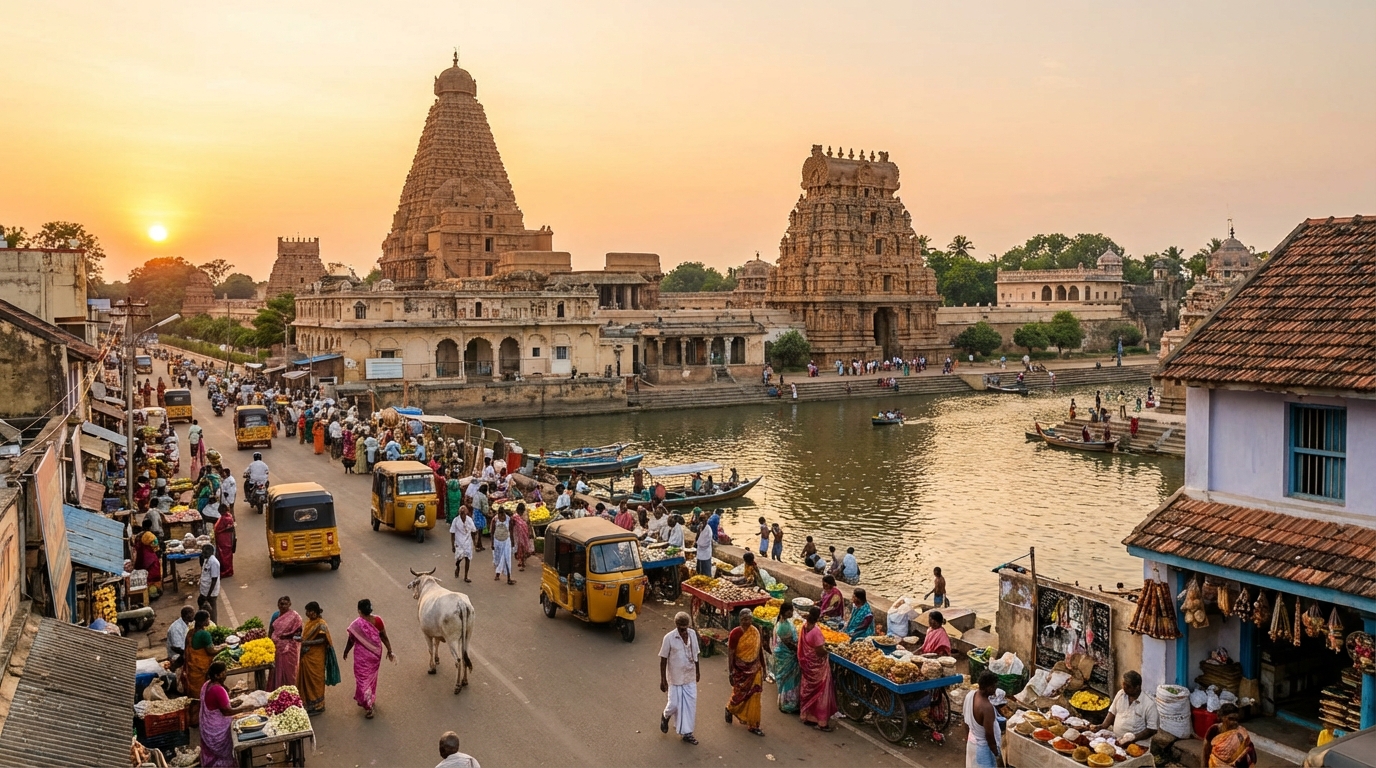
Thanjavur is a city in the Tamil Nadu region of India. Thanjavur sits 320 kilometers south of Chennai in the fertile Cauvery Delta, serving as the architectural core of the Chola Empire. It is most striking for its 1,000-year-old granite structures that rose from a landscape entirely devoid of natural stone.
Geography
The terrain is a flat alluvial fan at 59 meters above sea level, sustained by the 2,100-year-old Grand Anicut dam. The climate reaches 40 degrees Celsius in May, creating a humid atmosphere that allows the river to branch into a network of 36 irrigation channels across the district.
History
In 1010 CE, Emperor Rajaraja Chola I inaugurated the Brihadisvara Temple, marking Thanjavur as the administrative center of South India. This pivotal moment consolidated power through a sophisticated taxation system recorded on temple walls, transforming a regional settlement into a maritime empire that controlled trade routes to Southeast Asia.
Landmarks
- Brihadisvara Temple: The 81-ton monolithic granite capstone was hauled up a 6-kilometer earthen ramp to sit atop the 66-meter hollow tower.
- Saraswathi Mahal Library: Established in the 16th century, it houses 60,000 palm-leaf manuscripts and unique maps of 18th-century European cities.
- Schwartz Church: Built in 1779, this white-washed structure contains a marble monument depicting Raja Serfoji II visiting his dying German mentor.
- Punnainallur Mariamman Temple: The central deity here is composed entirely of a mixture of 12 medicinal herbs, rather than traditional stone or metal.
- Thanjavur Art Gallery: Located in the Maratha Palace, it holds bronze idols from the 9th century that show the precise anatomy of Chola royalty.
Cuisine
The kitchen relies on short-grain Ponni rice grown in the surrounding delta. The Marathi influence from 1674 CE introduced unique seasoning techniques, like the use of poppy seeds and tamarind bases that differ from northern Tamil styles.
- Ashoka Halwa: A glossy, orange dessert made from moong dal and ghee, first popularized in nearby Thiruvaiyaru for wedding feasts.
- Thanjavur Sambar: Legend claims this lentil stew was named after Maratha ruler Sambhaji when local cooks substituted tamarind for kokum.
- Kavuni Arisi: A sticky black rice pudding introduced by traders from Southeast Asia, now a staple at local Chettiar wedding breakfasts.
- Degree Coffee: Prepared using undiluted cow's milk tested with a lactometer, ensuring a thick froth that supports heavy chicory-blend decoction.
- Panakam: A cooling ritual drink made from jaggery, crushed cardamom, and dry ginger, served specifically during April's Rama Navami.
Culture
Culture revolves around the 2,000-year-old Carnatic music tradition and the precision of Bharatanatyam dance. Locals often dress in heavy silks that mirror the intricate carvings of their temples during agricultural festivals.
- Thyagaraja Aradhana: Every January, hundreds of musicians gather in Thiruvaiyaru to sing five specific Pancharatna Kritis in unison by the riverbank.
- Sathaya Vizha: Celebrated in October, it honors Rajaraja Chola’s birthday with grand processions and floral offerings to his bronze statue.
- Brihadisvara Chariot Festival: In April, a massive 7-meter-tall wooden chariot is pulled through the four main streets by thousands of locals.
- Thanjavur Silk Saree: Distinguished by heavy gold zari borders and temple motifs, these are hand-woven for weddings and weigh over 800 grams.
- Veshti with Angavastram: A 4-meter white cotton wrap for men, paired with a shoulder cloth featuring a gold border for temple visits.
- Pavadai Dhavani: A three-piece transition garment consisting of a skirt, blouse, and veil worn by girls during ceremony rites.
- Madisar: A complex 9-yard silk saree draped in a specific style that combines a trouser-like bottom with upper pleats.
- Panchakacham: A formal way for men to drape the veshti with five tucks, symbolizing the five natural elements.